Sustainable Promotional Products: What’s Legit vs Greenwashing
Sustainability has become a major focus when it comes to promotional products, and for good reason. More businesses want branded merchandise that reflects real environmental responsibility, not just surface-level messaging. But, as demand grows, so does something less helpful: Greenwashing.
However, the challenge isn’t just in finding better products- it’s in knowing how to tell the difference between what’s genuinely responsible and what’s just smart marketing.
Why Eco-Conscious Promo Products Matter More Than Ever
First, promotional products are more than just giveaways- they’re physical extensions of your brand! When someone keeps and uses an item, your brand stays in their daily environment.
And nowadays, audiences are paying closer attention to what brands distribute- especially when they make claims of being environmentally conscious. A reusable, well-made item can strengthen your reputation- but a cheap or disposable product can do the opposite.
Choosing better options helps you:
- Reduce waste from short-life promotional items
- Strengthen brand trust and perception
- Support more responsible sourcing and production
- Increase long-term product use and visibility
- Align marketing with environmental goals
Remember: Sustainability isn’t about perfection- it’s about making more intentional choices that hold up over time!
What Makes a Product Truly Sustainable?
This is where things get complicated. Many promotional items use sustainability language that sounds strong but lacks any real detail.
This is what’s known as Greenwashing. For those unfamiliar with the term, Greenwashing refers to marketing that exaggerates or misrepresents environmental benefits, including products listed as being “eco-friendly” without any meaningful proof behind those claims.
However, research published in Harvard Business Review shows that misleading claims don’t just confuse consumers- they can directly damage customer trust, brand reputation, and even a company’s bottom line.
Understanding that impact makes it easier to evaluate products with a more critical eye.
Move beyond vague claims
Terms like “green,” “eco-friendly,” or “earth-conscious” are often unregulated- They can be used even when the environmental benefit is minimal!
Instead, look for specifics such as:
- Exact recycled content percentages
- Renewable or responsibly sourced materials
- Durable, reusable construction
- Transparent supply chain details
- Reduced or recyclable packaging
If a supplier can’t explain the claim clearly, it’s usually a red flag.
Focus on items people will actually use
One of the simplest filters is usefulness. If someone won’t keep the item, it’s not sustainable in practice.
A durable, reusable product almost always outperforms a novelty item labeled “eco-friendly.”
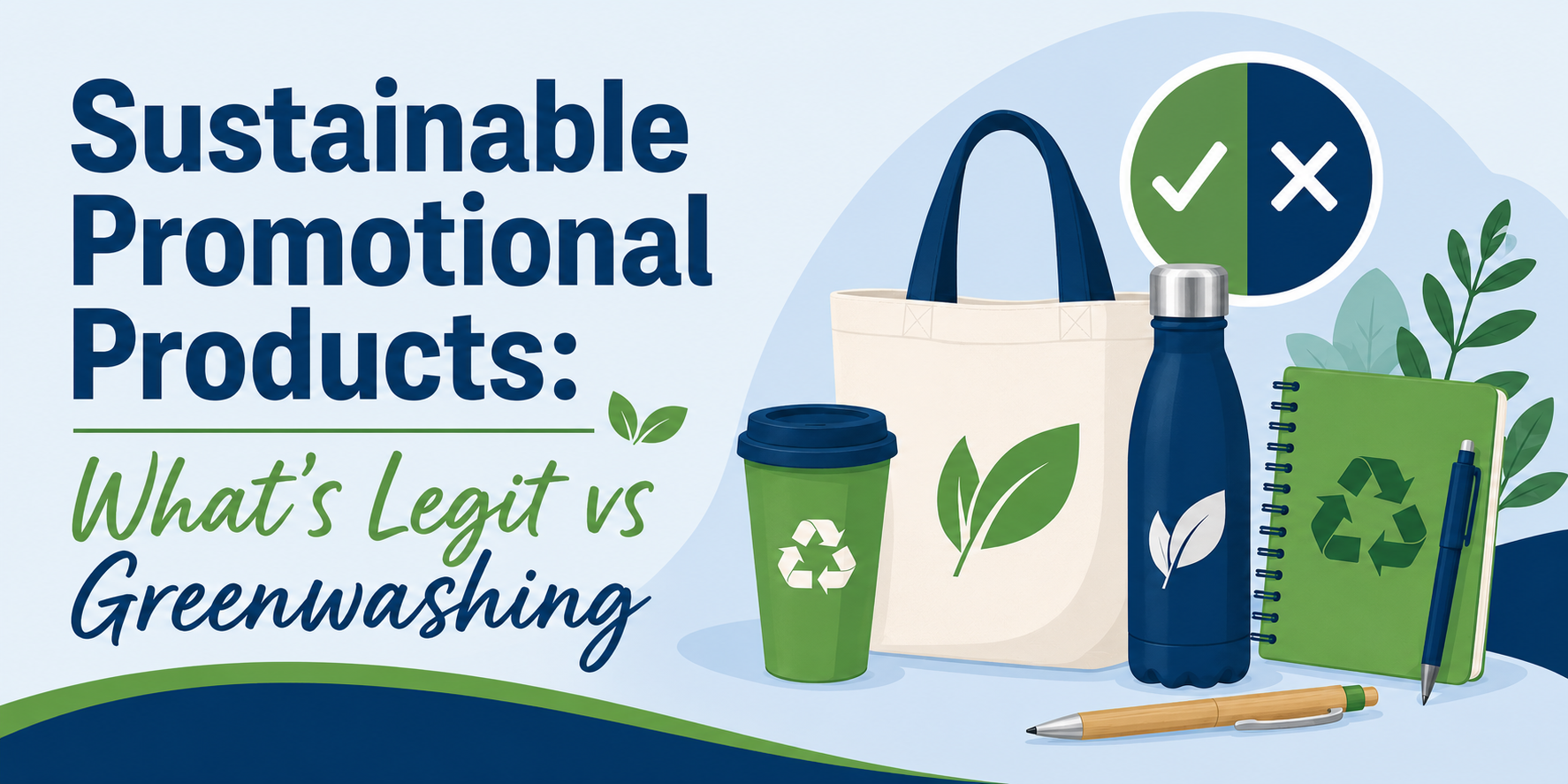
Strong examples include:
- Reusable water bottles and tumblers
- Tote bags made from recycled or organic materials
- Bamboo or wood desk accessories
- Recycled notebooks and journals
- Stainless steel food containers
- Solar-powered tech accessories
- Reusable utensil sets
The best items fit naturally into daily routines- that’s what extends their lifespan and impact.
Look for verified standards
Certifications can help confirm whether sustainability claims are credible. They’re not perfect, but they add accountability.
Common certifications include:
- FSC certification for paper and wood products
- Global Recycled Standard (GRS)
- Fair Trade certification
- OEKO-TEX for textiles
- USDA Organic materials
If no verification or sourcing detail is available, it’s definitely worth asking more questions before committing.
Greenwashing Red Flags to Look Out For
Not every product labeled “eco” is misleading, but there are patterns that should make you pause.
Vague or emotional language
If a product relies heavily on feel-good wording without explanation, be cautious. Real sustainability claims should be clear and measurable.
Small changes presented as major impact
A product with a small percentage of recycled material may still be heavily marketed as sustainable. (That doesn’t always reflect meaningful environmental improvement…)
Packaging that undermines the message
A reusable item wrapped in excessive plastic contradicts its own purpose. Packaging is part of the product’s total footprint!
Disposable products labeled as “better”
Compostable or biodegradable items can still create waste if they’re designed to be single use. “Better than plastic” does not always mean “low impact.”
Why Authenticity Matters for Your Brand’s Sustainability Strategy
Your promotional products are a part of your brand experience. People connect the item with the company that gave it to them!
If your messaging supports sustainability but your products don’t reflect that, audiences will notice the disconnect. On the other hand, when your merchandise is thoughtful, durable, and responsibly sourced, it reinforces trust without needing to say much at all.
This also extends your brand’s visibility, as a well-made reusable item can stay in use for months or even years, creating ongoing exposure in a natural way.
Ultimately, strong branding isn’t just about visibility- it’s about consistency. But when sustainability claims align with the actual product experience, it strengthens your long-term credibility.
Making Better Choices (Without Overcomplicating It)
You don’t need to do a complete overhaul to improve your promotional strategy. Small, consistent decisions can and do make a difference.
Start with simple priorities:
- Choose quality over quantity
- Ask suppliers for sourcing details
- Favor reusable items over single-use products
- Focus on usefulness before novelty
- Treat sustainability as a standard, not a trend
Over time, these choices naturally improve both environmental impact and brand perception.
Ready to Build a More Sustainable Promo Strategy?
If you’re looking to align your promotional products with sustainability goals while maintaining a strong brand impact, the right guidance helps make the process easier.
At Brand Advantage LLC, we help businesses source branded merchandise that balances quality, practicality, and responsible production. From eco-conscious giveaways to full campaign planning, we help you choose products that make sense for your brand. Contact our team today!